

Pearl River A lot of companies have been moving their corporate offices and re-registering in states that are more business-friendly moving from California and Delaware for example to Texas, where everything seems to go their way. Target, the huge retailer, is based in Minnesota, where it has its deep roots. Given the way Minnesota and the Minneapolis-St. Paul area have become ground zero first for Black Lives Matter after the police killing of George Floyd and more recently the killing of protestors by immigration agents during the mass deportation campaign, they have been forced to navigate difficult political events. They may wish they were headquartered somewhere else, too.
Outside observers might have said they did well for a while. They adopted a series of diversity, equity and inclusion programs for their stores and their supply chain in the wake of the Floyd murder that found ready applause in many corporate and consumer circles. Then came Trump. Target folded like one of the cheap suits they were selling off of one of their racks in the men’s department and backed off of DEI when it came under attack. Certainly, they weren’t alone among companies with no backbone, but being consumer-facing, they stood out. Some churches and others declared a boycott and the company has acknowledged “that shopper anger over its DEI policy shifts played a role in the poor results last year.” Reports from some of the boycott leaders claim that Target has “acknowledged a breakdown in trust with the Black community” and “have reinforced their support of supplier diversity and historically Black colleges and universities in a series of meetings with activists….” Some boycott organizers have now declared victory.
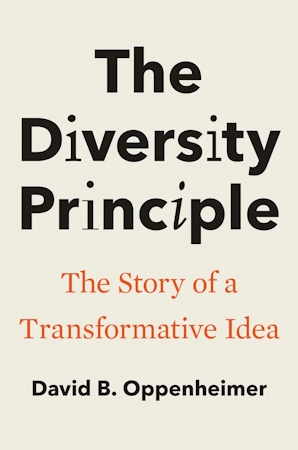
I talked recently to University of California at Berkeley law school professor David Oppenheimer about his work, The Diversity Principle: The Story of a Transformative Idea. Notwithstanding, the current administration’s war on “woke”, he found the real roots of diversity as a critical cultural and educational value stretch back hundreds of years. The British political philosopher, John Stuart Mill and his wife, argued the case that moved so many of the American founders. The German statesman and education Humboldt was a pioneering advocate of the value of diversity in scholarship and academic pursuits. Unsung legal scholars, like Pauli Murray, made this a key argument that drove civil rights decisions. Archibald Cox, a key figure in the famous Sunday wave of resignations over Watergate subsequently made the case as an attorney for Harvard, which was often cited in Supreme Court decisions as a positive academic, social, and cultural principle.
The boycotters have it right. The fight against DEI is a fight not against diversity, but against difference and its value. It’s code for virulent white replacement concerns and racism. Target may have been forced to come around, but many corporations and universities also buckled and though shamed, have not again embraced the values of a multi-cultural society and nation. That fight isn’t over and seems to have hardly begun.