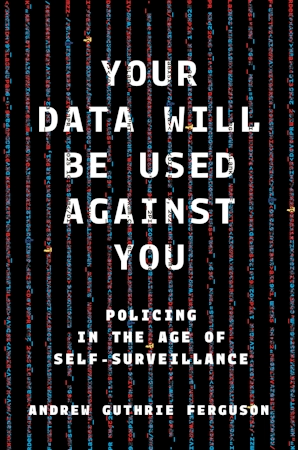


New Orleans When it comes to surveillance the key takeaway is that we know better, but we can’t help ourselves. We’ve almost lost the fight before we even suit up for the battle. All of this came home hard when I was talking to George Washington University Law School Professor Andrew Guthrie Ferguson about his new book, Your Data Will Be Used Against You: Policing in the Age of Self-Surveillance.
We all know where we stand on the issue of surveillance. None of us want to be spied on, especially by the government or police, but also by the rest of corporate gang. Ferguson has taken as his mission reminding us that we are aiding and abetting these privacy intrusions because so much of modern technology is crack to us.
We do this to ourselves, particularly with our cellphones. As we make calls or read emails or whatever on them and the signal moves from tower to tower to keep up or ahead of us, we can be tracked and the information doesn’t disappear. There’s a reason on the cops-and-robbers show on TV that the first thing people do when they are on the run is throw their phones out of the window or stamp them to death. You are kidding yourself if you think it is easy to get a phone which strips away the internet or a burner, just like on The Wire. A brave soul in my family went this route, but it almost broke her within a few months, she was so disconnected from literally everything.
Think about yourself. You need a cellphone for all two-step verification. Yes, it stops hackers, but it also enables surveillance. I still have paper maps and consult atlases in my work in organizing and media, but I’m lying if I tell you I don’t use Google Maps once I jump in my truck. We all kid about living in the world that Google, Amazon, and the rest have now made, but it’s gallows humor that cuts close to the bone. Long schooled about the fact that Google never deletes anything, for years no one at ACORN was allowed to use Gmail for organizational business. I still don’t, we have our own email server, but I talk to the wind with our affiliates in Canada and the UK who use Google as their email tool. Recently, in a random situation, someone was able to pull up and log every search on an address. Heck, I’m lucky if I can search my own emails, so it’s disconcerting to think that anyone can pull that up almost at random with minimal access.
Ferguson is talking about how this impacts policing. We all think we’re innocent and protected, but in many countries, including my own, that are racing toward autocracy, I wonder exactly how far any of us are from the long arm of the law for almost any excuse? I wasn’t happy to read that camera placements in the New Orleans French Quarter were the testing ground for Palantir, the super invasive military and police contractor. Even now, the new mayor is talking about duplicating that level of intrusion and facial software in New Orleans East, a large middle-income and largely African-America neighborhood in the city, and not Uptown for example. So much of this is racially discriminatory.
I’m only sharing the tip of the iceberg from reading and talking to Ferguson. He offers some advice particularly for police and governments about transparency and accountability, as well as the need for judicial warrants. All that is good, but as long as we all keep fueling these business models with our data, there seems no way short of being a hermit in a cave in the mountain to not enable self-surveillance, unless we get these companies under control.