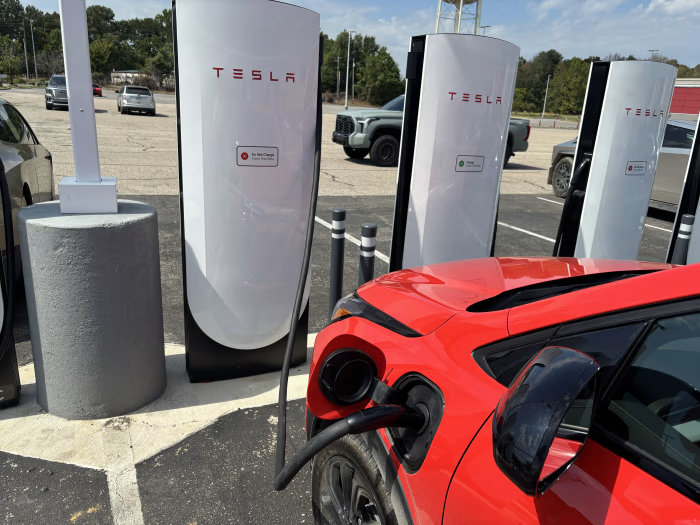


New Orleans Electric vehicles are the hot sellers all over China with multiple companies in the market. Reportedly sales are also increasing in Europe. In the US, Ford and General Motors in recent years made major investments in EVs, but have now pulled back without government support under the Trump regime. Elon Musk, long known for Tesla, rather than all of his reactionary rages in recent years, at one time understood that for these vehicles to sell it meant ubiquitous access to chargers, and not just chargers, but fast chargers. Like so many of his promises, the pledge to install them nationally has long been abandoned.
I follow all this at some distance, because I’m mildly sensitive, driving a really large, 4WD Chevy Silverado pickup making my life on the road and stints in the Ozarks and bayou country more navigable on and off the road and needing more horses to pull our array of multi-purposed trailers. Mi companera drives a hybrid Ford product and seems to go weeks on a tank of gas. She needles me from time to time about this, but it’s pretty much water off a duck’s back.
I do maintain my argument though that living in the middle south and constantly traveling between Mississippi, Arkansas, and Louisiana, that we’re not ready for EVs in this part of the USA. A couple of years ago there was a classic article by an intrepid Wall Street Journal reporter assigned to take an EV and drive it from New Orleans to Chicago. It was horror story of broken and non-existent charging stations, long delays and forced overnighters. The subhead was that she spent more time charging than sleeping. Hardly, a recommendation to head for the dealers!
Admittedly, that was over four years ago, so it’s fair to ask whether it’s gotten better or is still about the same, making EVs an option at home and in the city, but a disaster on the open road or on frequent drives. Catching up on back papers when back in New Orleans recently, a chart caught my eye that another reporter named Mims tried to drive from Nashville to New Orleans. This chart was a bit more nuanced, because it included both the price paid for the charge, as well as the time it took to get charged enough to get back on the road.
Mims tried to be a little bit of a booster and more positive, and, admittedly, it wasn’t as hair raising a tale, but it still indicated it was a long way from primetime. His first stop was 130 miles from Nashville; it took 30 minutes to get 2/3rds charged at the cost of $22 and change. Next stop, 93 miles, 50% charged for $18 in 20 minutes. In Little Rock, a full hour to get to 90% for $31.43. You can see where this going. He was stopping at 160, 205, 132, 128, and 79 miles for 130 or more minutes. Even in my truck, filling up in the beginning, I would have stopped once, since I get 450 miles on a tank and even at Iran War prices at $3.59 per gallon, (although I actually filled up at $3.41 my last trip), I would have paid $89.75. Mims claims his cost was $140.04, but doesn’t include the first charge. Let’s assume, by his chart, that was another $35 for a total cost of $175. Doing the same, I would have paid $179.50, a couple of bucks more. On the other hand, my stop was 5 minutes compared to his 130, and that doesn’t count the original pitstop, which for me was another 5 minutes and for Mims another hour, so in time spent, we’re looking at my 10 minutes to his 190 minutes.
I hate to beat a dead horse here, but I’m not a reporter for the Journal, I’ve got a job to do still, that’s true, but I also have people waiting for me on both ends of every trail, and my idea of a bad time would be twiddling my thumbs for three hours waiting for a charge, and that’s not even counting what it takes to find a charging location that’s convenient. We’re also not even talking about costs, which are still pretty steep for most makes of EVs. It’s hard not to conclude that we’re a long, long way from having the infrastructure to make EVs good for the road for anyone’s time and money.